EN
EN

EN
- Home
- About Us
-
Products
Products
- Capabilities
- Projects
- News
- Contact Us
2026/06/21
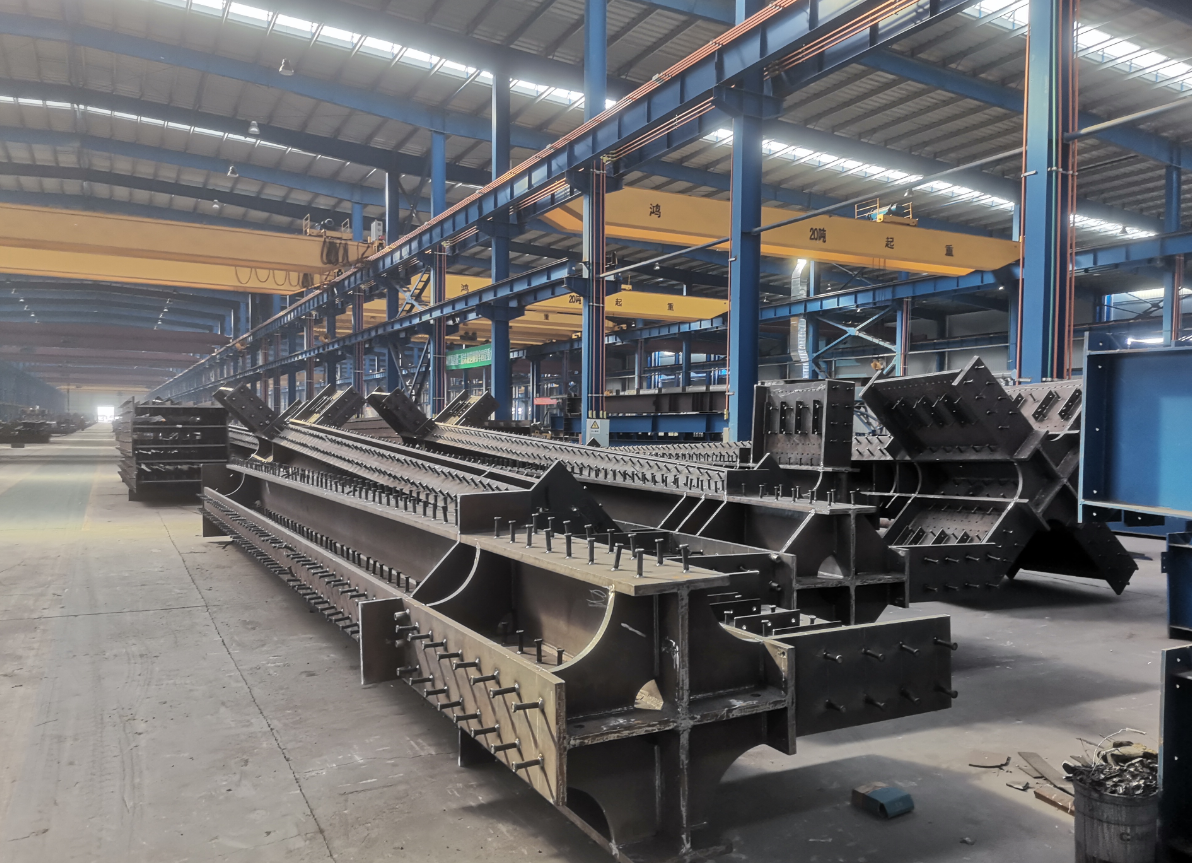
A steel truss is a framework of interconnected members arranged in triangles that converts bending loads into pure axial tension and compression within each member. A solid beam resists bending by distributing stress unevenly through its cross-section — material near the neutral axis contributes little. A truss puts every kilogram of steel to work carrying tension or compression along the member axis. The result is a structure spanning distances a solid beam of equal weight cannot approach.
The triangle is the only polygon that cannot change shape without changing side lengths. A steel truss exploits this by subdividing a rectangular frame into triangles. The top chord carries compression — the downward push of roof loads, snow, and self-weight. The bottom chord carries tension — the pulling force preventing the truss from spreading at its supports. Web members — verticals and diagonals — transfer loads between the chords. Which members are in tension or compression depends on truss configuration and loading, and this is what differentiates one type from another.
A logistics warehouse in Eastern China required a clear-span roof of 40 meters — any interior column would obstruct forklift aisles. A solid beam would have needed a section depth approaching 2 meters, consuming vertical clearance and adding dead weight. A steel truss — a Pratt configuration with 3.2-meter depth — achieved the span with standard hot-rolled H-beam sections. Diagonals were oriented so longer members carried tension (efficient in steel) and shorter verticals carried compression. Total steel weight was approximately 40% less than the equivalent solid-beam solution, and the open web allowed ducts, sprinkler piping, and lighting to pass through the truss rather than hanging below it.
The Warren steel truss uses equilateral or isosceles triangles with alternating diagonals and no verticals. Loads alternate between tension and compression in successive diagonals. It is the simplest to fabricate because member lengths and connection angles repeat. Warren trusses suit spans of 15 to 60 meters where uniform depth is acceptable and loading is symmetrical.
The Pratt steel truss orients diagonals outward and downward from center toward supports, putting longer diagonals in tension and shorter verticals in compression under gravity load. This is efficient because steel handles tension better than compression — long tension members avoid buckling. Pratt trusses suit 20 to 80 meters and are the most common choice for industrial building roofs.
The Howe steel truss reverses the Pratt: diagonals slope inward and upward from supports, putting diagonals in compression and verticals in tension. Less efficient in steel (long compression members risk buckling), Howe trusses are more common in timber. In steel, they are used where uplift from wind reverses the normal load pattern.
The Fink steel truss subdivides the basic triangle into smaller triangles radiating from center, creating a fan-like web reducing unsupported chord lengths. Fink trusses are standard for residential and light commercial pitched roofs of 10 to 25 meters — they use less steel per square meter than Warren or Pratt for short to medium spans with steep pitches.
Selection for a steel truss project starts with four questions. First, what is the clear span? This determines truss depth — typically span/10 to span/15 for roofs, span/8 to span/12 for bridges. Second, what are the loads — dead, live, snow, and wind — because asymmetrical loading may favor Pratt over Warren. Third, what vertical clearance is available? A shallow truss requires heavier chords; a deep truss may conflict with mechanical systems. Fourth, is the truss exposed? An architecturally exposed steel truss in a public space may justify a visually compelling Warren pattern even if Pratt is marginally more efficient.
A steel truss is only as strong as its connections. Bolted connections with gusset plates are standard for site assembly — they allow adjustment and are inspectable. Welded connections provide higher stiffness for shop-fabricated trusses delivered complete. Lateral bracing — connecting adjacent trusses with purlins and cross-bracing — prevents individual trusses from buckling out of plane. Corrosion protection — hot-dip galvanizing for exterior exposure to ISO 1461, intumescent paint for fire-rated interiors — must be specified at design stage.
The four primary steel truss types are Warren (alternating diagonals, no verticals), Pratt (long diagonals in tension under gravity), Howe (diagonals in compression under gravity), and Fink (fan-like web for pitched roofs). Each optimizes member forces differently.
The Pratt steel truss puts longer web members in tension and shorter verticals in compression under gravity loading. Steel performs better in tension than compression — long tension members avoid buckling — making Pratt the structurally efficient default for industrial roofs.
A steel truss spans from 10 meters for a Fink residential roof to over 100 meters for deep Warren or Pratt trusses in hangars and stadiums. Truss depth increases with span — typically span/10 to span/15 for roofs.
Bolted connections are standard for site-assembled steel truss structures — they allow adjustment and are inspectable. Welded connections provide higher stiffness and suit shop-fabricated trusses delivered complete. The choice depends on fabrication and erection logistics.
A Warren steel truss uses alternating diagonals forming equilateral triangles with no verticals — simple to fabricate. A Pratt adds verticals and puts diagonals in tension under gravity — more efficient in steel but slightly more complex.
A steel truss in exterior exposure requires hot-dip galvanizing to ISO 1461 or a multi-coat paint system. Interior trusses in dry spaces may need only a primer. Fire-rated applications require intumescent paint to the specified dry film thickness.
Explore our latest company news, project cases and industry insights.