EN
EN

EN
- Home
- About Us
-
Products
Products
- Capabilities
- Projects
- News
- Contact Us
2026/06/24
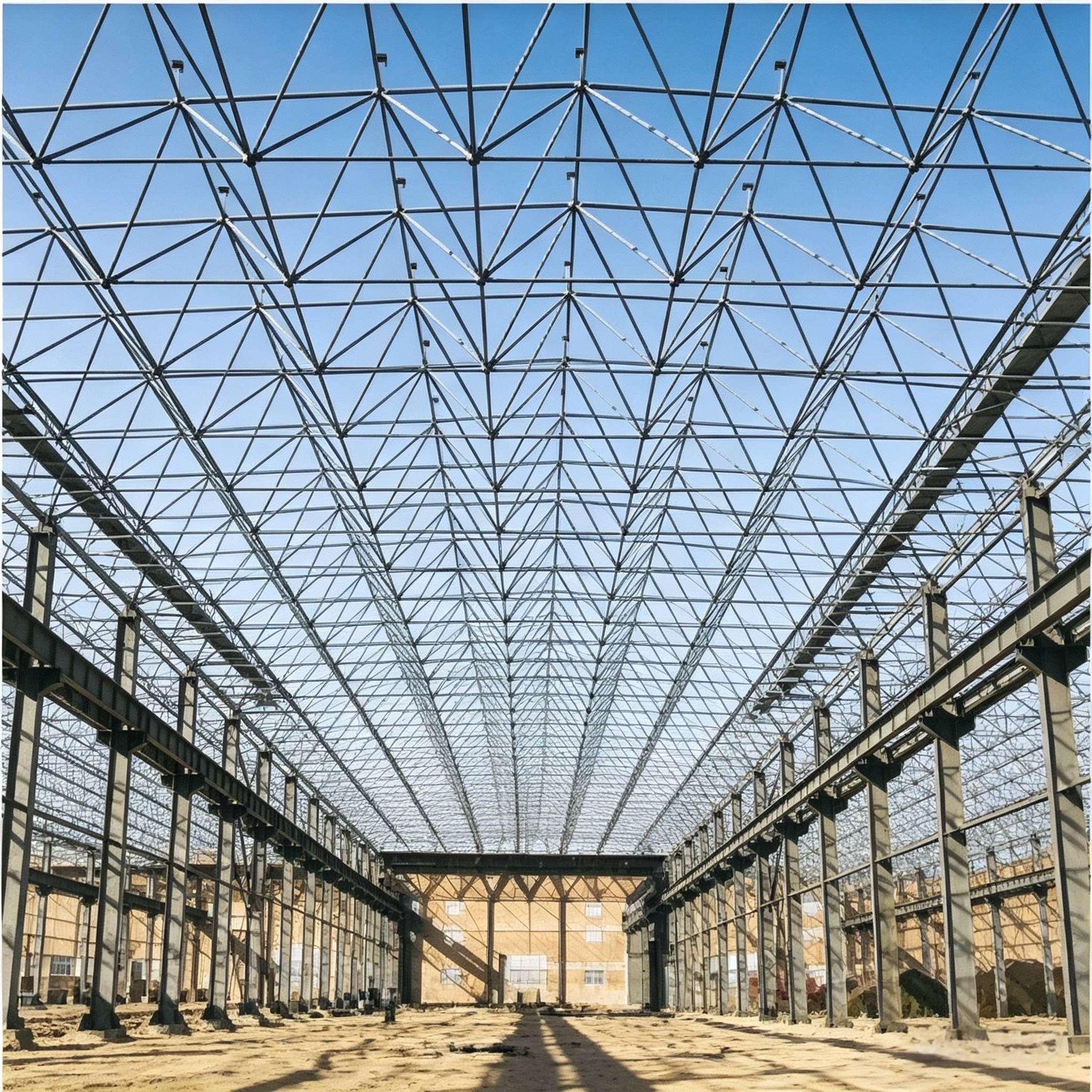
A steel truss perfectly designed for dead and live loads but not for wind uplift fails when a storm passes — suction on the leeward side exceeds dead load, the bottom chord goes into compression, and the truss buckles upward. Load determination is the condition that governs every subsequent design decision.
Four load cases control steel truss design. Dead load — truss self-weight (0.10 to 0.25 kN/m²) plus purlins, sheathing, insulation, and ceiling — is permanent. Live load — 0.6 to 1.0 kN/m² per ASCE 7 — covers construction and maintenance. Wind load per ASCE 7 Chapter 27 or Eurocode 1 Part 1-4 is the most complex: positive pressure on the windward wall, suction on the roof, and internal pressure coefficients varying with openings. A steel truss without uplift analysis may have bottom chord capacity in tension but insufficient compression capacity when wind reverses the load. Snow load — 0.5 to 4.0+ kN/m² depending on ground snow, exposure, thermal factor, and roof slope — governs in cold climates. Drift accumulation at parapets and roof level changes concentrates load on a portion of the truss the uniform-load design did not anticipate.
A 30-meter-span warehouse in a 1.5 kN/m² ground snow region experienced partial roof deflection — not collapse, but visible sagging. Investigation found the original steel truss design assumed uniform snow. The building had a parapet causing snow drifting — ASCE 7 drift provisions predict 2.2 kN/m² over the first 6 meters near the parapet. zeyongsteel (Zhejiang Zeyong Steel Structure Engineering), a company with first-class steel structure contracting qualification, AAA credit rating, and partnerships with China Railway Construction and China Railway Group, redesigned the truss with strengthened top chords in the drift zone and additional web members. The warehouse has operated through two subsequent heavy-snow winters with zero deflection.
The configuration of a steel truss determines which members are in compression and tension — which determines material efficiency. A Pratt truss (verticals in compression, diagonals in tension) is efficient for 10 to 30-meter spans — shorter verticals resist buckling better than longer diagonals. A Warren truss (alternating diagonals in equilateral or isosceles triangles) uses fewer members, reducing fabrication cost, and is standard for 15 to 40 meters. A Howe truss (diagonals in compression) is used where bottom chord ceiling loads reverse the diagonal stress direction. A Fink truss (fan-shaped webs from a central peak) is standard for pitched residential roofs at 8 to 15 meters. Configuration is a material-efficiency decision: longer compression members need larger sections to prevent buckling.
The chord members of a steel truss are designed for axial force — tension in the bottom chord, compression in the top chord, and stress reversal under wind uplift. Section selection balances area (axial capacity) against radius of gyration (buckling resistance). Hollow structural sections (HSS) provide uniform compression efficiency — a 100×100×5 HSS has r≈39 mm in both axes versus a comparable wide-flange with r=45 mm strong-axis and r=25 mm weak-axis. Slenderness ratio for compression members should not exceed 200 per AISC 360 Section E2. Gusset plates at web-to-chord joints — typically 8 to 12 mm for 20 to 30-meter spans — transfer axial force from web members into chords with welds per AISC 360 Chapter J or EN 1993-1-8. Undersized connections are the most common failure initiation point.
A steel truss is stable in its plane — triangulation resists in-plane forces. Out-of-plane, the truss is a slender column that buckles laterally without bracing. Roof bracing — diagonal rods or angles at the top chord connecting adjacent trusses — provides restraint at 6 to 8-meter intervals. Bottom chord bracing does the same for the bottom chord during wind uplift. Purlin-sheathing diaphragm action — metal deck screwed to purlins bolted to the top chord — creates a stiff diaphragm transferring lateral wind loads to sidewall bracing. A truss designed without bracing contribution is heavier and costlier than necessary; a truss relying on absent bracing is unsafe.
A Warren truss provides the best stability-to-material ratio for steel truss spans of 15 to 40 meters. Pratt trusses are efficient for 10 to 30 meters. zeyongsteel designs and fabricates all major truss configurations.
Wind uplift on a steel truss reverses member forces — the bottom chord goes from tension to compression, and the top chord from compression to tension. Bottom chord bracing is essential to prevent lateral buckling under uplift conditions.
A steel truss can span 50+ meters for commercial and industrial roofs with deep truss profiles (span/10 to span/15 depth ratio). Residential trusses typically span 8 to 15 meters. zeyongsteel has built benchmark steel structure projects across infrastructure and venue categories.
Snow drift loads on a steel truss near parapets and roof level changes can concentrate 50% to 100% higher load on a portion of the span per ASCE 7 drift provisions. Local member reinforcement in the drift zone is required.
A steel truss requires top chord bracing at 6 to 8 meter intervals, bottom chord bracing for wind uplift zones, and a roof diaphragm formed by the metal deck connected to purlins. Bracing prevents out-of-plane buckling.
Steel truss connections use gusset plates of 8 to 12 mm thickness with fillet welds sized per AISC 360 or EN 1993-1-8. Undersized connections are the most common failure initiation point — weld sizing must match the web member axial capacity.
Explore our latest company news, project cases and industry insights.