EN
EN

EN
- Home
- About Us
-
Products
Products
- Capabilities
- Projects
- News
- Contact Us
2026/06/16
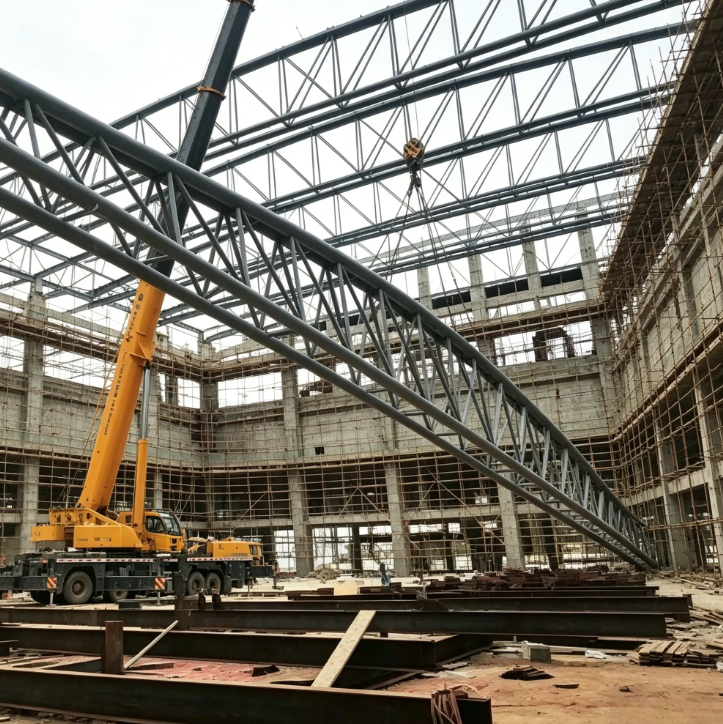
Construction budgets rarely exceed expectations because of a single expensive item. More often, costs accumulate through hundreds of small design decisions — beam sizes chosen without load-zone analysis, connections optimized for shop convenience rather than assembly speed, redundant members adding tonnage without adding safety. A steel structure project that undergoes rigorous optimization before fabrication drawings can cut total steel tonnage by 10% to 20% while maintaining full structural integrity.
Building Information Modeling software such as Tekla Structures allows engineers to model every beam, column, and connection of a steel structure virtually before ordering. The advantage is load-path analysis at the member level. Rather than uniform safety factors across an entire frame, BIM-linked analysis identifies exactly which members carry the highest stresses. Profiles can then be right-sized: a column at H350 might drop to H300 in low-load zones.
Connection design is another optimization lever. Standardized bolted connections reduce fabrication labor and erection time. Limiting unique connection types to four or five instead of twelve lets the shop program CNC equipment once and repeat — and the erection crew accelerates through subsequent bays. A shorter schedule means lower crane rental and less site overhead.
A logistics company in Zhejiang planned a 12,000-square-meter distribution warehouse with an initial estimate of 480 tons of structural steel. The project team engaged an engineering firm during schematic design for value-engineering review.
Tekla-based modeling revealed column grid spacing at 6 meters could expand to 8 meters with minor beam-depth increases, reducing the column count by 22%. Secondary framing consolidated from six profiles to three, and connections standardized across all joints. Final tonnage dropped to 408 — a 15% reduction. Fewer columns meant less foundation concrete. Standardized connections let erection finish in 28 days instead of 35, saving a week of crane rental.
Traditional on-site steel fabrication introduces cost-inflating variables: weather downtime, measurement rework, material exposure before enclosure. Prefabrication moves cutting, welding, drilling, and coating into a climate-controlled factory where CNC lines and robotic cells operate with repeatable precision, cutting on-site labor by 30% to 50% Modular Construction Cost Analysis.
Components arrive pre-cut, pre-drilled, often pre-painted, needing only bolting. For any steel structure project, fewer skilled workers on site for fewer days is one of the largest cost-reduction levers. CNC nesting software pushes material yield above 90% versus 75% to 80% from manual field cutting, and just-in-time delivery in erection sequence eliminates double-handling.
Steel prices fluctuate, but procurement cost is not simply per-ton price. A fabricator with ISO 9001 quality management and ISO 14001 environmental credentials delivers value beyond the mill certificate — dimensional accuracy means fewer rejected pieces, traceable heat numbers support compliance, documented processes reduce delays.
Supplier qualification should weigh capacity, certifications, and project references — not just quoted tonnage. A fabricator with established mill relationships negotiates better pricing. On the lifecycle side, hot-dip galvanizing costs more upfront than basic paint but eliminates decades of repainting — for industrial steel structure applications in corrosive environments, the long-term calculation strongly favors durable surface protection.
First, engage the structural engineering team during conceptual design — value engineering applied early yields multiples of later savings. Second, audit the fabrication partner's CNC capability and ISO 9001 certification; automated production correlates directly with dimensional precision. Third, standardize connections — every unique detail adds setup time and learning curve. Fourth, evaluate total lifecycle cost; a galvanized frame lasting 50 years costs more per ton but less per year than a painted frame needing recoating every decade. Fifth, confirm logistics sequencing: steel should arrive in erection order, labeled by bay and elevation.
A well-planned steel structure project controls cost through design discipline, production efficiency, and supply chain rigor — not by cutting corners on material or connection quality.
A steel structure is a building framework where primary load-bearing members — columns, beams, trusses, and bracing — are fabricated from structural steel. Applications span industrial warehouses, factory buildings, commercial towers, airport terminals, sports arenas, and long-span bridges. The high strength-to-weight ratio and design flexibility make it the default choice for large-clear-span and heavy-load projects.
Rigorous optimization through BIM-based modeling typically reduces total steel tonnage by 10% to 20%, with savings in fabrication, transportation, and erection. The largest gains come from right-sizing members to load paths, reducing unique connection types, and optimizing column grid spacing to balance beam depth against column count.
Prefabrication shifts cutting, drilling, welding, and coating into a factory where CNC automation delivers higher throughput, better material yield, and consistent quality. On-site labor drops by 30% to 50%, material waste decreases significantly, and weather delays are eliminated. Components arrive ready to bolt up, compressing erection schedules.
BIM enables load-path analysis at member level, clash detection before fabrication, and automated shop drawings with CNC data. These capabilities reduce design errors, eliminate field rework, and allow connection standardization that accelerates both fabrication and erection. The model supports precise quantity takeoffs for procurement.
Selection should weigh ISO 9001 quality certification, ISO 14001 environmental management credentials, and AISC or equivalent fabrication capability alongside production capacity and project references. The lowest per-ton quote often hides costs in dimensional rework, missing traceability, and schedule delays that compound across the project.
Total ownership cost includes surface protection, passive fireproofing, and maintenance access over the building's service life. Hot-dip galvanizing adds upfront cost but eliminates repainting for 50-plus years. Fire protection integrated during structural engineering costs less and performs better than spray-applied retrofits added after erection.
Explore our latest company news, project cases and industry insights.